Friday, January 1, 2016
Intentional
I love making New Year's Resolutions, but because I'm human, I am truly terrible at keeping them. They're a perennial (literally) favourite of mine! And, not to brag, but a lot of the resolutions I've set for myself over the past few years have come to pass, even if they were sort of by accident. I've made my peace with my body (or at least I had; we'll just have to see what a post-baby incarnation looks like and what kind of spirit work it requires), which means I no longer "need" to lose x-number of pounds. I've accepted my Coke Zero habit, mostly don't eat junk food, and I quit smoking ages ago.
But that doesn't mean there aren't things in my life that wouldn't benefit from some changes. Resolutions, adjustments, goals, habits to break or create, things I need to examine or challenge, and all the other work that goes into the improvement of a human being. In the spirit of the new year, here are some of my 2016 goals:
1. Set a monthly intention. A friend of mine does this, and I think it's pure genius. Whether it's practicing more gratitude, getting outside more often, working on a relationship that needs some TLC, or some other goal, holding it in my mind for a month seems doable. I'm a person who, every so often, will "make a five year plan": this is literally just a half-baked spreadsheet with columns like FINANCE and LOVE and I'm stumped on how to fill out the cells. I do much better with short-term goals, like giving up sugar or social media for a month, and I often find that these experiments act as a window into my priorities. Like, giving up sugar was horrible, because it tapped into the obsessive, punitive part of my brain. Better to just have a bit of chocolate and be cool with it, you know? Anyway, a monthly intention may just be enough focus in a year which I'm sure will have its share of hairiness.
2. Stop taking everything so damn personally. I am...not very good at this. From other people's weddings to celebrity bodies, it can be a real challenge to remember that these things are not happening at me, and I don't need to react to them as though I've been personally wronged. This happens literally all the time, from the mundane (I didn't win an Instagram giveaway! I am bad at Instagram and am also a loser!) to the meaningful (before I was married, unchecked jealousy over other people's engagements left me feeling like I'd been doused in lye). Being able to celebrate people's milestones and accomplishments is the mark of a healthy soul, and it's something I need to cultivate in myself before I shrivel up into a husk. I've been working on this for years already, so this is more of a reminder to, you know, keep at it!
As a corollary, if my husband happens to have a grumpy face when he's talking to me, he might not be grumpy at me (although he definitely might be: I have been known to push a button or two). I want to be able to hear past an angry tone, an interruption, or a misspoken word, and not weaponize it and turn it back onto the person. I want to be able to hear the message without getting all bent out of shape about the delivery. Personal criticism is vital for growth (prune the dead branches, etc), but it doesn't always come in an embossed envelope, delivered by singing baby angels.
3. Stop swearing (in conversation). I love salty language. I've peppered my speech with forbidden words since the fifth grade, when I realized that my parents weren't actually in class with me and couldn't do much about it (my big transgression? Telling a classmate to shut up, which, along with hate, stupid, and dumb, was definitely Not Allowed in my house). I swear like a sailor with my friends and my therapists, and I love it. It's fun! But, if I'm being perfectly honest, swearing is also sort of déclassé and aggressive. I hate that I'm more likely to drop an f-bomb when I'm angry, or when I'm trying to come across as cool or tough. Removing rough language from my speech doesn't mean I don't feel angry, or want to seem cool or tough; it just means I don't have a convenient crutch to lean on to convey those thigs. And I can definitely keep using the whole dictionary, including the R-rated entries, in my writing. Sometimes, a sister just needs to write fuuuuuck, you know?
2016 is going be a nutty year for a lot of different reasons. We're transitioning from a two-person family to welcoming a third. My parents and siblings are in flux right now, and "home" is undergoing a radical redefinition. I have creative projects simmering in my brain, but they've not yet come to full boil. And, as the year passes, time will stretch and slow like it always does. The days will be long and the weeks short, and vice versa. "One day at a time" is such a cliche, but even cliches have their usefulness.
Tuesday, December 29, 2015
The Girl and the Bird
Once upon a time, there was a girl who lived in the city. She was a happy girl, more or less: she had friends and family near and far, and she had a bike to ride, and good food to eat, and a happy boy by her side. The girl was a wild one: she wore feathers in her hair and rode her bike on the empty streets of the midnight city, daring the world to come up and meet her.
Most often, the world did.
One night, the girl was riding her bike when she happened across a tiny bird in the middle of the street. The bird did not fly away when she pedaled towards it; instead, it cocked its head at her and blinked. Despite its tiny size, it seemed fearless. The girl slowed her bike down. The streetlight pooled orange glow across the road, and the moon rose slowly beside them.
The girl looked at the bird. The bird looked at the girl. Nothing around them moved. Even the treetops were still. The girl smiled gently, silently inviting the little bird closer. The bird hopped, once, twice, then stopped. The girl smiled. A tenderness flew through her, unexpected on this ordinary night.
Then the bird let out one small sound, and its body fell to the side. Its tiny talons curled up, and its eyes closed.
Dead? Dead.
The girl let out a cry she did not hear. Without thinking, she scooped the little bird up into her hand. It weighed barely anything at all: it was lighter than a rose in bloom, smaller than a handful of snow. It did not move as she held it near to her face. She looked through tears for signs of life.
Nothing.
The girl was still astride her bicycle, still in the middle of the street. Because she didn't know what else to do, she swung leg over her frame and carried the tiny body over to the sidewalk. She placed the bird gently on the pavement, then stood and looked at it from her full girl's height.
It was so small. Surely nothing this small could have suffered for long.
The girl sat on the curb and allowed her sadness to rise up. A sob slipped out, then another. The night around her blurred into orange light and shadows. The moon's full face disappeared under her tears. The bird lay beside her, quiet in death.
Then the girl heard a sound. Another bird had landed, cheeping madly at the girl, at the tiny body beside her. Then another bird landed. Soon, the girl and the body were surrounded by a tiny quorum of birds, all crying into the night.
The girl pushed herself back up to her feet. The birds fell silent for a moment, watching her rise. Then they turned their attention back to the death at hand. It was impossible for the girl to know—were these other birds friends? Family? Perhaps a lovebird, drawn to the scene by the tidal knowledge of death? All mourning in their own raptorish way?
As the girl watched, each took a turn running its beak along their fallen friend's feathers. It was a gentle thing, made strange and beautiful under the orange glow of the streetlight. The birds paid her no heed as they tended to their friend.
The girl walked back to her bicycle and looked once more at the birds on the sidewalk. They were silent now, looking down at the tiny body.
The girl did not smile as she rode away, but neither did she cry. Instead, she felt the love she held in her heart for her own flock rise up over the city like a wing on the breeze.
Image via Karl Martens via My Modern Met
Most often, the world did.
One night, the girl was riding her bike when she happened across a tiny bird in the middle of the street. The bird did not fly away when she pedaled towards it; instead, it cocked its head at her and blinked. Despite its tiny size, it seemed fearless. The girl slowed her bike down. The streetlight pooled orange glow across the road, and the moon rose slowly beside them.
The girl looked at the bird. The bird looked at the girl. Nothing around them moved. Even the treetops were still. The girl smiled gently, silently inviting the little bird closer. The bird hopped, once, twice, then stopped. The girl smiled. A tenderness flew through her, unexpected on this ordinary night.
Then the bird let out one small sound, and its body fell to the side. Its tiny talons curled up, and its eyes closed.
Dead? Dead.
The girl let out a cry she did not hear. Without thinking, she scooped the little bird up into her hand. It weighed barely anything at all: it was lighter than a rose in bloom, smaller than a handful of snow. It did not move as she held it near to her face. She looked through tears for signs of life.
Nothing.
The girl was still astride her bicycle, still in the middle of the street. Because she didn't know what else to do, she swung leg over her frame and carried the tiny body over to the sidewalk. She placed the bird gently on the pavement, then stood and looked at it from her full girl's height.
It was so small. Surely nothing this small could have suffered for long.
The girl sat on the curb and allowed her sadness to rise up. A sob slipped out, then another. The night around her blurred into orange light and shadows. The moon's full face disappeared under her tears. The bird lay beside her, quiet in death.
Then the girl heard a sound. Another bird had landed, cheeping madly at the girl, at the tiny body beside her. Then another bird landed. Soon, the girl and the body were surrounded by a tiny quorum of birds, all crying into the night.
The girl pushed herself back up to her feet. The birds fell silent for a moment, watching her rise. Then they turned their attention back to the death at hand. It was impossible for the girl to know—were these other birds friends? Family? Perhaps a lovebird, drawn to the scene by the tidal knowledge of death? All mourning in their own raptorish way?
As the girl watched, each took a turn running its beak along their fallen friend's feathers. It was a gentle thing, made strange and beautiful under the orange glow of the streetlight. The birds paid her no heed as they tended to their friend.
The girl walked back to her bicycle and looked once more at the birds on the sidewalk. They were silent now, looking down at the tiny body.
The girl did not smile as she rode away, but neither did she cry. Instead, she felt the love she held in her heart for her own flock rise up over the city like a wing on the breeze.
Image via Karl Martens via My Modern Met
Sunday, December 20, 2015
Things That Happened in 2015
January: We kick off the year with a gorgeous sunny day and two feasts. Brunch is, and probably always will be, one of my favourite meals to eat outside the house (and, to be honest, inside the house and also beside the house and pretty much anywhere, let's be real), so when Julia invites us over for a New Year's Day brunch, and it's bright and sunny, how can we say no? A few hours later, a group of us troop over to Mother's Dumplings in Chinatown and eat our body weight in dumplings and Chinese broccoli; then we all decamp to our place to watch Blade Runner. This is the way every year starts now, and it's one of my favourite traditions.
February: I head up to the Beaver Valley to spend the Family Day weekend with friends, while Mike stays home to play catchup with work. The weekend is relatively uneventful—board games, homemade dinners, reading the New Yorker in bed—except for the afternoon I spend nearly freezing to death on the side of the road.
The story? The general store, which is across the street from Emmett's house, does not carry pretzels, and when I ask where is the nearest store that does, the clerk waves her hand and says, "About eight minutes up the road, just out of the valley." I figure, hey: I'm dressed warmly. I've got a backlog of 99% Invisible episodes queued up on my iPod. I'll walk to get some pretzels! So I set out. It's sadistically cold outside, but the sun is shining and it's all okay.
After about fifteen minutes, I'm halfway out of the valley and there has been no store. After about thirty-five minutes, I am fully out of the valley, picking my way down the side of the road, grimly determined to come back with pretzels, dammit. Roman Mars drones in my ear. After forty-five minutes, I give up. There are no stores, barely any houses, and I am way, way out of town.
When I turn around, I realize that I've been walking with the wind at my back. Now, the -38 windchill racks my face, shooting into my hood, stinging my eyes, ruddying my cheeks immediately. I get a chill that has nothing to do with the temperature: it's my body recognizing that I am in serious trouble a half-second before my brain does. I have no phone, I don't know Emmett's number, and I am deeply fucked. The snot running down my face freezes, but I'm too cold to feel it.I can barely catch my breath.
By the time I get back to the top of the Beaver valley, the sun has begun to set. By the time I get back to the general store, the temperature has dropped another few degrees. The clerk looks up as I re-enter the store. "Did you get your pretzels?" she asks cheerily. I ignore her question and say, "When you said 'eight minutes,' did you mean walking or driving?"
She has the good grace to look stricken.
To punish her, I buy a very expensive gluten-free butter tart and a warm can of Diet Coke, and return to Emmett's. He and Hannah look up when I come in. "Where'd you go?" he says mildly.
"I need to sit in front of the fireplace for a while," I say. My face is red and the skin around my mouth and nose is raw and heedless of touch. It will stay that way for nearly a week.
March: I quit my job! After five months of working with a boss who doesn't understand the difference between an executive assistant, an office manager, and a 24/7 on-call mindreader who is expected to know the difference between ahem and aHEM when he clears his throat/asks for something, I'm ready to move on. Also, the ceiling in our apartment's bathroom caves in. The two are not related.
April: I get my first writing commission, I start a new column at Torontoist, we meet an astronaut, I start writing for Yonge Street Media, and I can do two and a half minutes of burpees without vomiting. I am terrified that I will never have any money again, but things are happening, and it feels good.
May: Pregnant. Pregnant! Pregnant. PREGNANT. We are pregnant. I am pregnant. It is the weirdest thing. I feel totally normal—I keep working out, I keep riding my bike, my appetite is pretty good—and I assume, like an idiot, that the entire pregnancy will progress this way. Somewhere, the goddess rubs her hands together with glee and engraves several lightning bolts of Truth and Calamity with my name.
June: Ah, here we are. I feel like garbage. I get an ultrasound, and yes, there is a tiny human jellybean inside of me. It has a heartbeat. Later in the month, I vomit on the sidewalk in front of a bar. I'm definitely pregnant.
July: My dad has cancer. A melanoma that was not-quite-excised from his cheek six years ago has hid quietly in his body; now, it's back, with lumps under his arm and in his lungs. I tell him that I love him. Later that night, I get up and go into the bathroom and weep. Then I write down all the things I know about him: memories, sayings, advice, his story, his life. I force myself to write it in the present tense.
I tell some friends, but not many: the process of telling people is exhausting. My dad is vibrant, vivacious, funny, and very much alive. Cancer, especially melanoma, is widely regarded as a death sentence. I realize that telling people means comforting them, and I am too exhausted to do that. I keep the news mostly to myself. He starts treatment, an immunotherapy that turbocharges his blood and allows him to keep his quality of life high.
August: The bar below our apartment begins extensive renovations. We are awoken most days at 7 AM, and work often continues past midnight, seven days a week The demolition is loud—think tile drillers, concrete drills, jackhammers—and we receive no notice that it's happening. Contacting the landlord reveals nothing. I end up texting with the site foreman, who is livid on our behalf that we weren't told in advance, or updated...but the landlords are also his bosses and they want this job done yesterday. Our fire alarm rings at odd times. The water periodically shuts off. Contractors show up unannounced at our door to fix these problems, and leave having broken the fire alarm. I feel like I'm going insane.
September: We move. Our new place is on a residential street, on the ground floor of a house. We have a tiny playground just down the road, and all of Saint Clair West to explore. It's a nice place to have a baby. But also: I throw my back out lifting boxes, and it takes weeks to recover. My pregnancy hormones are through the roof. Our new bathtub is too small for me to sit in comfortably, so a major self-care ritual disappears from my life. All I want to do is cry. Instead, I call my midwife, and she refers me to a prenatal psychiatrist. I do not feel better, but I feel like I could feel better, and that's good enough for now.
October: My dad finishes cancer treatment. I go to Stratford for a week to spend time with my parents, and to visit my out-of-province sister, and I drink champagne with him. We listen to miraculous baseball games on the radio. We cheers—"To life!" every time—and sometimes we cry. Things could be good, or maybe bad, but for now, we're all together. It feels close enough to normal, but of course, it's not.
When I get back to Toronto, our downstairs neighbour falls asleep with his deep-fryer running and starts a fire. At 11:50 PM on the Monday of the Thanksgiving weekend, we are on the sidewalk, frantically trying to figure out where we might sleep that night, because our apartment—our new apartment!—is full of smoke.
Later that week, we have a gas leak in our apartment. It is impossible not to think dark thoughts.
November: I spend three days with my mom, driving around Prince Edward County, swimming in salt water pools, eating fancy-ish meals, and just feeling held. I take many baths. I read several issues of The New Yorker.
We get the test results back for my dad: the lumps under his arms are gone, and the ones in his lungs are much smaller. It is possible to feel like things might be okay, at least for a while. Okay, and a while, are enough.
The baby is kicking, moving, tumbling through me. I check out books about natural childbirth from the library and do not read them. January feels close. I look down and I don't see a pregnant body—I see a fat one—and I realize with a start that, even though I've been pregnant for six months, I still haven't internalized it. I am flooded with terror about motherhood, and about delivery, and about change. It's a huge feeling, made huger by the fact that I didn't really know it was there. It's like opening your door one morning and discovering that you now live on the top of a mountain; it's still possible to do stuff, but the commute takes longer and you're tired by the end of it. M is so supportive. I have fallen in love with him in a deeper way, and this takes me by surprise.
December: We are doing our best to prepare for baby, and also save money, and also finally unpack everything from the move, but things are slow. In lieu of shopping or cooking, I knit like a fiend. Socks and baby hats and tiny sweaters fly off my needles. I listen to hours and hours of podcasts. We offer to host Christmas dinner. We take prenatal classes. We lie in bed and read to each other. My back hurts, so I sleep on the couch. I take pictures of my stomach. M and I see Star Wars: The Force Awakens and he is pleased. I do the crossword. We eat perogies and burritos, rum cake and stir fry. We invite people to our house to watch Blade Runner on New Year's Day.
February: I head up to the Beaver Valley to spend the Family Day weekend with friends, while Mike stays home to play catchup with work. The weekend is relatively uneventful—board games, homemade dinners, reading the New Yorker in bed—except for the afternoon I spend nearly freezing to death on the side of the road.
The story? The general store, which is across the street from Emmett's house, does not carry pretzels, and when I ask where is the nearest store that does, the clerk waves her hand and says, "About eight minutes up the road, just out of the valley." I figure, hey: I'm dressed warmly. I've got a backlog of 99% Invisible episodes queued up on my iPod. I'll walk to get some pretzels! So I set out. It's sadistically cold outside, but the sun is shining and it's all okay.
After about fifteen minutes, I'm halfway out of the valley and there has been no store. After about thirty-five minutes, I am fully out of the valley, picking my way down the side of the road, grimly determined to come back with pretzels, dammit. Roman Mars drones in my ear. After forty-five minutes, I give up. There are no stores, barely any houses, and I am way, way out of town.
When I turn around, I realize that I've been walking with the wind at my back. Now, the -38 windchill racks my face, shooting into my hood, stinging my eyes, ruddying my cheeks immediately. I get a chill that has nothing to do with the temperature: it's my body recognizing that I am in serious trouble a half-second before my brain does. I have no phone, I don't know Emmett's number, and I am deeply fucked. The snot running down my face freezes, but I'm too cold to feel it.I can barely catch my breath.
By the time I get back to the top of the Beaver valley, the sun has begun to set. By the time I get back to the general store, the temperature has dropped another few degrees. The clerk looks up as I re-enter the store. "Did you get your pretzels?" she asks cheerily. I ignore her question and say, "When you said 'eight minutes,' did you mean walking or driving?"
She has the good grace to look stricken.
To punish her, I buy a very expensive gluten-free butter tart and a warm can of Diet Coke, and return to Emmett's. He and Hannah look up when I come in. "Where'd you go?" he says mildly.
"I need to sit in front of the fireplace for a while," I say. My face is red and the skin around my mouth and nose is raw and heedless of touch. It will stay that way for nearly a week.
March: I quit my job! After five months of working with a boss who doesn't understand the difference between an executive assistant, an office manager, and a 24/7 on-call mindreader who is expected to know the difference between ahem and aHEM when he clears his throat/asks for something, I'm ready to move on. Also, the ceiling in our apartment's bathroom caves in. The two are not related.
April: I get my first writing commission, I start a new column at Torontoist, we meet an astronaut, I start writing for Yonge Street Media, and I can do two and a half minutes of burpees without vomiting. I am terrified that I will never have any money again, but things are happening, and it feels good.
May: Pregnant. Pregnant! Pregnant. PREGNANT. We are pregnant. I am pregnant. It is the weirdest thing. I feel totally normal—I keep working out, I keep riding my bike, my appetite is pretty good—and I assume, like an idiot, that the entire pregnancy will progress this way. Somewhere, the goddess rubs her hands together with glee and engraves several lightning bolts of Truth and Calamity with my name.
June: Ah, here we are. I feel like garbage. I get an ultrasound, and yes, there is a tiny human jellybean inside of me. It has a heartbeat. Later in the month, I vomit on the sidewalk in front of a bar. I'm definitely pregnant.
July: My dad has cancer. A melanoma that was not-quite-excised from his cheek six years ago has hid quietly in his body; now, it's back, with lumps under his arm and in his lungs. I tell him that I love him. Later that night, I get up and go into the bathroom and weep. Then I write down all the things I know about him: memories, sayings, advice, his story, his life. I force myself to write it in the present tense.
I tell some friends, but not many: the process of telling people is exhausting. My dad is vibrant, vivacious, funny, and very much alive. Cancer, especially melanoma, is widely regarded as a death sentence. I realize that telling people means comforting them, and I am too exhausted to do that. I keep the news mostly to myself. He starts treatment, an immunotherapy that turbocharges his blood and allows him to keep his quality of life high.
August: The bar below our apartment begins extensive renovations. We are awoken most days at 7 AM, and work often continues past midnight, seven days a week The demolition is loud—think tile drillers, concrete drills, jackhammers—and we receive no notice that it's happening. Contacting the landlord reveals nothing. I end up texting with the site foreman, who is livid on our behalf that we weren't told in advance, or updated...but the landlords are also his bosses and they want this job done yesterday. Our fire alarm rings at odd times. The water periodically shuts off. Contractors show up unannounced at our door to fix these problems, and leave having broken the fire alarm. I feel like I'm going insane.
September: We move. Our new place is on a residential street, on the ground floor of a house. We have a tiny playground just down the road, and all of Saint Clair West to explore. It's a nice place to have a baby. But also: I throw my back out lifting boxes, and it takes weeks to recover. My pregnancy hormones are through the roof. Our new bathtub is too small for me to sit in comfortably, so a major self-care ritual disappears from my life. All I want to do is cry. Instead, I call my midwife, and she refers me to a prenatal psychiatrist. I do not feel better, but I feel like I could feel better, and that's good enough for now.
October: My dad finishes cancer treatment. I go to Stratford for a week to spend time with my parents, and to visit my out-of-province sister, and I drink champagne with him. We listen to miraculous baseball games on the radio. We cheers—"To life!" every time—and sometimes we cry. Things could be good, or maybe bad, but for now, we're all together. It feels close enough to normal, but of course, it's not.
When I get back to Toronto, our downstairs neighbour falls asleep with his deep-fryer running and starts a fire. At 11:50 PM on the Monday of the Thanksgiving weekend, we are on the sidewalk, frantically trying to figure out where we might sleep that night, because our apartment—our new apartment!—is full of smoke.
Later that week, we have a gas leak in our apartment. It is impossible not to think dark thoughts.
November: I spend three days with my mom, driving around Prince Edward County, swimming in salt water pools, eating fancy-ish meals, and just feeling held. I take many baths. I read several issues of The New Yorker.
We get the test results back for my dad: the lumps under his arms are gone, and the ones in his lungs are much smaller. It is possible to feel like things might be okay, at least for a while. Okay, and a while, are enough.
The baby is kicking, moving, tumbling through me. I check out books about natural childbirth from the library and do not read them. January feels close. I look down and I don't see a pregnant body—I see a fat one—and I realize with a start that, even though I've been pregnant for six months, I still haven't internalized it. I am flooded with terror about motherhood, and about delivery, and about change. It's a huge feeling, made huger by the fact that I didn't really know it was there. It's like opening your door one morning and discovering that you now live on the top of a mountain; it's still possible to do stuff, but the commute takes longer and you're tired by the end of it. M is so supportive. I have fallen in love with him in a deeper way, and this takes me by surprise.
December: We are doing our best to prepare for baby, and also save money, and also finally unpack everything from the move, but things are slow. In lieu of shopping or cooking, I knit like a fiend. Socks and baby hats and tiny sweaters fly off my needles. I listen to hours and hours of podcasts. We offer to host Christmas dinner. We take prenatal classes. We lie in bed and read to each other. My back hurts, so I sleep on the couch. I take pictures of my stomach. M and I see Star Wars: The Force Awakens and he is pleased. I do the crossword. We eat perogies and burritos, rum cake and stir fry. We invite people to our house to watch Blade Runner on New Year's Day.
Saturday, December 19, 2015
The Force
Full disclosure: Star Wars, as an experience, wasn't really part of my childhood vernacular. I think my parents—my dad, probably—sat us all down at some point and showed us the original movie. In some ways, this was likely along the same lines as "sometimes we go to church," or, "yes, you have to learn fractions": just another thing to teach your kids so that they grow up to be well-rounded adults.
I have a distinct memory of being utterly confused by the trash compactor scene in Star Wars: I had somehow missed their descent down the chute, and I was flummoxed by the eel-thing that seemed to live there, and frankly, the whole idea of compacting a room full of wet garbage was just weird enough for me to not really grasp wtf was going on. As the movie went on, already-familiar pop culture icons like Darth Vader shared the screen with ideas that seemed to make no sense, like blowing up a moon-sized space station by firing into an exhaust pipe. (I mean, say what you will about George Lucas, but he honored the shit out of the sanitation department in that movie.) I remember walking away feeling sort of confused, and maybe a little let down—that was what the hype was about?
I don't remember if there were follow-up home screenings of The Empire Strikes Back and Return of the Jedi. I was sixteen when the prequels started coming out, and I remember leaving the theatres with that same sense of let-down-ness: was that it? A bunch of dudes in housecoats flipping around with light sabers, interminable political "drama," and Natalie Portman dressed in either parade floats, or a midriff-baring fighting ensemble? This was what everyone had been waiting for?
Actually, no. I know now that the prequels are widely regarded as terrible, but at the time, I wasn't sure enough in my own critical voice to make that statement. In the face of high school nerds, who wield a powerful nerdery indeed, it seemed impossible that the prequels might not actually be any good. And, in 1999 (much like today), the hype machine around these movies was absurd. Besides, there were always the old movies to fall back on, with Lando and Boba Fett and the cantina on Mos Eisley. You know: the good ones. The blemish of the prequels couldn't mar the original trilogy; if anything, it heightened their importance, making them even more precious.
In 2010, I lived with my parents for a summer, and I undertook a crash course in film and pop culture: I watched Michael Fassbender's Hunger and the X-Men movies, I watched a jillion Westerns and Hitchcock flicks, and I watched classic cartoon. I rented out half the video shelf of the local library, figuring that, if they thought these were worth spending taxpayer dollars on, I should probably see them. It was that summer I decided to revisit the Star Wars universe.
Again, they failed to imprint themselves on my heart. But at least this time, I could kind of figure out why. As a pop-culture phenomenon, Star Wars isn't designed for 26-year-old women who are killing time before they have to go wait tables; it's meant for people who can obsessively comb through the entire universe, learning the names of various minor characters, robot models, and alien races. It's meant to introduce the Western and the Ronin and the Opera and the Love Story to kids and tweens, to show them that stories, no matter where they're set or who they star, often have the same skeletons under their skins. It opens up metaphysical questions around good and evil, and the choices we make about those forces, but leaves the concept of God or a church well outside the frame. It is storytelling 101, each building block neatly lined up beside the next one, and just different enough from anything that had come before to seem fresh and important.
Which brings me to The Force Awakens. A girlfriend recently asked me, "On a scale of zero to ten, how many fucks do you give about Star Wars?" I conceded that I give three fucks: one for the sheer intensity of the pop-culture phenomenon; one for my husband, who loves these movies; and one for my curiosity about if these new installations are going to live up to the original trilogy, or bottom out like the prequels did.
I would love to spoil The Force Awakens for you, but I will not. But I'll say this: the new movie is fun. It doesn't really matter if you're heavily invested in either the original trilogy or the prequels—as long as you have a passing knowledge of characters (which is pretty standard in 21st century life), you'll be fine. This movie is darker and more explosive that the loins from which it sprang; it's also funnier, more beautiful, and more feminist than anything that came before it. It is silly and serious, important and also a trifle, and very fun to watch. It's definitely a 21st century Star Wars, but I think that makes it better: it fits into the original canon but doesn't try to match it beat for beat.
If you want to introduce your kids to Star Wars, don't start with the Force Awakens. Start with the original trilogy, and let them (maybe) be bored and confused. Movie-making has changed dramatically in the last forty years, and going from Star Wars to The Force Awakens shows exactly how much. But same bones of story—family, adventure, new romance, ancient forces—are still vibrant and present across all the movies. The old ones are still relevant, even as they get a little creaky; the new one, despite its whippersnapperish peacocking, is more than able to hang with its ancestors.
Oh, and it goes without saying: skip the prequels. Nobody's kids need to see that.
I have a distinct memory of being utterly confused by the trash compactor scene in Star Wars: I had somehow missed their descent down the chute, and I was flummoxed by the eel-thing that seemed to live there, and frankly, the whole idea of compacting a room full of wet garbage was just weird enough for me to not really grasp wtf was going on. As the movie went on, already-familiar pop culture icons like Darth Vader shared the screen with ideas that seemed to make no sense, like blowing up a moon-sized space station by firing into an exhaust pipe. (I mean, say what you will about George Lucas, but he honored the shit out of the sanitation department in that movie.) I remember walking away feeling sort of confused, and maybe a little let down—that was what the hype was about?
I don't remember if there were follow-up home screenings of The Empire Strikes Back and Return of the Jedi. I was sixteen when the prequels started coming out, and I remember leaving the theatres with that same sense of let-down-ness: was that it? A bunch of dudes in housecoats flipping around with light sabers, interminable political "drama," and Natalie Portman dressed in either parade floats, or a midriff-baring fighting ensemble? This was what everyone had been waiting for?
Actually, no. I know now that the prequels are widely regarded as terrible, but at the time, I wasn't sure enough in my own critical voice to make that statement. In the face of high school nerds, who wield a powerful nerdery indeed, it seemed impossible that the prequels might not actually be any good. And, in 1999 (much like today), the hype machine around these movies was absurd. Besides, there were always the old movies to fall back on, with Lando and Boba Fett and the cantina on Mos Eisley. You know: the good ones. The blemish of the prequels couldn't mar the original trilogy; if anything, it heightened their importance, making them even more precious.
In 2010, I lived with my parents for a summer, and I undertook a crash course in film and pop culture: I watched Michael Fassbender's Hunger and the X-Men movies, I watched a jillion Westerns and Hitchcock flicks, and I watched classic cartoon. I rented out half the video shelf of the local library, figuring that, if they thought these were worth spending taxpayer dollars on, I should probably see them. It was that summer I decided to revisit the Star Wars universe.
Again, they failed to imprint themselves on my heart. But at least this time, I could kind of figure out why. As a pop-culture phenomenon, Star Wars isn't designed for 26-year-old women who are killing time before they have to go wait tables; it's meant for people who can obsessively comb through the entire universe, learning the names of various minor characters, robot models, and alien races. It's meant to introduce the Western and the Ronin and the Opera and the Love Story to kids and tweens, to show them that stories, no matter where they're set or who they star, often have the same skeletons under their skins. It opens up metaphysical questions around good and evil, and the choices we make about those forces, but leaves the concept of God or a church well outside the frame. It is storytelling 101, each building block neatly lined up beside the next one, and just different enough from anything that had come before to seem fresh and important.
Which brings me to The Force Awakens. A girlfriend recently asked me, "On a scale of zero to ten, how many fucks do you give about Star Wars?" I conceded that I give three fucks: one for the sheer intensity of the pop-culture phenomenon; one for my husband, who loves these movies; and one for my curiosity about if these new installations are going to live up to the original trilogy, or bottom out like the prequels did.
I would love to spoil The Force Awakens for you, but I will not. But I'll say this: the new movie is fun. It doesn't really matter if you're heavily invested in either the original trilogy or the prequels—as long as you have a passing knowledge of characters (which is pretty standard in 21st century life), you'll be fine. This movie is darker and more explosive that the loins from which it sprang; it's also funnier, more beautiful, and more feminist than anything that came before it. It is silly and serious, important and also a trifle, and very fun to watch. It's definitely a 21st century Star Wars, but I think that makes it better: it fits into the original canon but doesn't try to match it beat for beat.
If you want to introduce your kids to Star Wars, don't start with the Force Awakens. Start with the original trilogy, and let them (maybe) be bored and confused. Movie-making has changed dramatically in the last forty years, and going from Star Wars to The Force Awakens shows exactly how much. But same bones of story—family, adventure, new romance, ancient forces—are still vibrant and present across all the movies. The old ones are still relevant, even as they get a little creaky; the new one, despite its whippersnapperish peacocking, is more than able to hang with its ancestors.
Oh, and it goes without saying: skip the prequels. Nobody's kids need to see that.
Saturday, December 12, 2015
Master of Some
Aziz Ansanri has never been "my" kind of comedian. Despite him being pretty much exactly the same age as me, I think of him as belonging to the 20-something set, maybe because his jokes are in the "modern foibles" category of comedy: lots of raised eyebrows at relationships, texting etiquette, and what-does-it-all-mean personal identity questions that dog most of through our formative years (and, in my case, waaaay beyond).
In what is probably his most famous role, Tom Haverford on Parks and Rec, Ansari played the archetype of a self-proclaimed big fish in a small pond. He was especially adept at playing the businessman-dreamer, which only really works when you're in a tiny town and you think your insane ideas are viable business options because you haven't seen the inevitable New York City iteration hit the skids.
Ansari is funny and personable, both as Tom and in his stand-up persona. His Wikipedia page proclaims that he's a feminist, which, in an age where male comedians constantly interrogate female comedians, and women generally, on their ability to perceive unfunny boys'-club "jokes" as anything other than subtle violence, is a relief. He's been on critically acclaimed shows, like Flight of the Conchords way back in '07, and done voice work for Adventure Time and the Venture Brothers. He was on Scrubs, acting as a bridge between the JD years and the terrible, best-to-be-ignored intern-centric reboot. He's made good choices!
Last month, he launched Master of None on Netlfix. He plays Dev, who's sort of like Hannah Horvath's to Ansari's Lena Dunham: Dev seems like a lightly fictionalized version of Ansari. Dev's single, a foodie, an emerging actor with a few commercials and a role in a terrible action movie under his belt. Ansari cast his real-life parents as Dev's parents, further blurring the line between reality and fiction (and, despite his mother's total inability to not look at the camera, their scenes are hella charming). Dev often speaks in the sing-song cadence that Aziz adopts in his stand-up sets, and has the same interest in surface/sparkle/shine that he embodied with Tom Haverford.
For the most part, I liked Master of None. It forefronted some interesting questions around race, in big ways (why don't we see more minorities in the media?) and in smaller ones (the "black virus" movie). It was especially smart around its treatment of second-generation immigrants—the kids whose parents might be intimately familiar with how to kill a chicken, but for whom chicken comes in nugget form only.
And yet, I can't love it unreservedly. It falls for a couple stupid sitcom storylines—kids will ruin your life, dummy! your relationships are doomed for failure!—and, despite their racial diversity, Dev's friends aren't actually characters we haven't seen before. The dialog feels stilted sometimes, as though the actors are reciting lines written by fourth graders.
We are in an age of comedian auteurs. People who started in stand-up or in other people's writer's rooms are now producing and starring in their own shows. With Louie or The Mindy Project or Master of None, we see autobiographical details bump up against the fantasy world of television. Someone, and I can't remember who, wrote that Louie is what happens when you actually dramatize the hyperbole that makes stand-up sets so funny; likewise, The Mindy Project is best understood as a rom-com, with all the meet-cutes and false barriers and redemption arcs that genre embraces. If I had to guess, I would say that Master of None works on upending our expectations of race and relationships? Or maybe it's about Millennials? Or...something else?
I can't quite put my finger on why I don't fully connect with Master of None. At first I thought it was because I am now an old grumpy pregnant married person, and this show is about being Young, Hot, and Fun™, but I watch plenty of shows that aren't directly about who I am in this current moment. But Master of None is so much about surfaces that it can be a little distracting.
The best moments on the show are when he decides to dig a little deeper—ask his parents about their immigrant experience, instead of keeping them at arm's length, or actually care about the experience of the women he works with, instead of assuming he already knows what their lives are like—but there are also so many moments when he focuses on the outward appearance of his life. He wants a relationship that's 100% perfect at all times; he wants the cleanest apartment; he wants the nattiest outfit. The idea that perfection and surface sheen are desirable, let alone achievable and maintainable, is barely examined. His sing-song cadence reinforces the notion that life is a thing to be performed rather than lived, and it's only in the last episode that we start seeing actions that challenge that, and there's precious little emotional work to go along with these changes.
Master of None is a good show—not a great show, but a good one—and watching it was a pleasure. Ansari raises interesting questions, and answers some of them adeptly. But still: I just wish there had been more there there, you know?
Saturday, December 5, 2015
Life Dreams
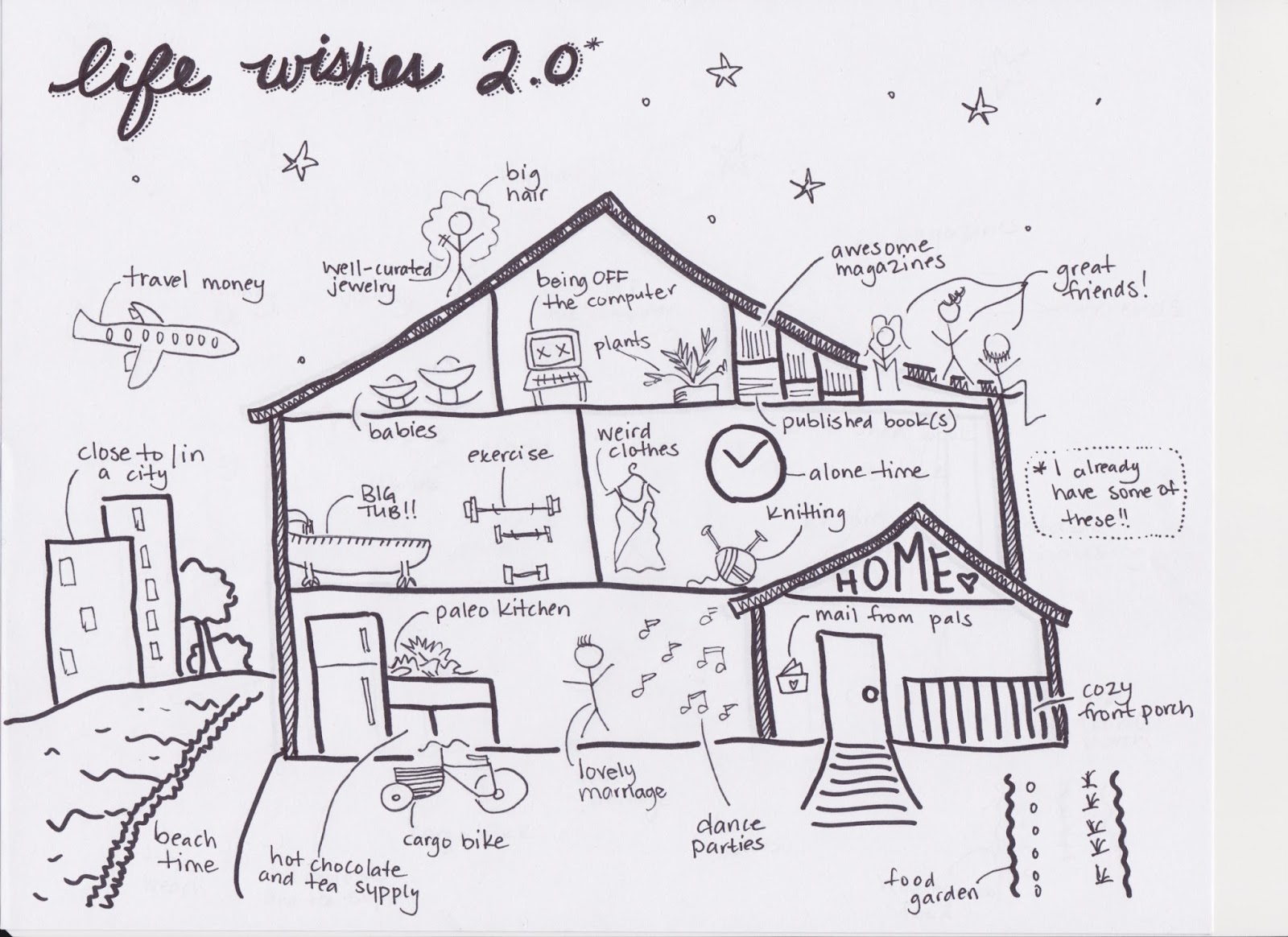
Back in 2010, I decided that I wanted to draw a map of what my life could look like. I've long been interested in—obsessed with?—the "ideal life"; not in that Martha Stewart Living kind of way, but rather asking myself, what are the things, moments, places, and people that make my life glow?
I've explored this a little on Twitter—I've been doing these word collages called "things to consider" for a few years, in which I just list different things that have been creating brainwaves for me lately. Sometimes these lists are themed—food, clothing, colours—but usually they're just lovely little dots in the matrix of my imagination. When I decided, last year, to organize them all into a spreadsheet, I found plenty of common themes among the nearly 2100 (!) different entries. I love gold jewelry (fifteen entries), the colour black (24 entries), babies (nine entries), plants (70 different entries, including marigolds, succulents, lavender, and wet grass), and the beach. Yoga turns up a surprising number of times for someone who does it only a couple dozen times each year, and the category of TV/Film generates only eighteen entries—and yes, of course I categorized my dreamy life list. I am a right brain/left brain cartoon character.
Having this wealth of information is probably self-indulgent, but it's also a great way to track the patterns in my life. Back in October of last year, when a friendship was falling apart in a grueling way, I found myself thinking about things like "being sad and being okay." In May of this year, I mentioned "hope" during the weird unknown cavern of time while we suspected I might be pregnant but before we could know for sure. A series of tweets about "feeling afraid," "fresh starts," and "home offices" in the weeks before I quit my job reinforced exactly how miserable I was. The seemingly minor details that make up the majority of the entries only make the real stuff stand out more.
So what to do with this information? Well, because I am the person I am—a dreamy planner, a reluctant doer—I drew a picture. I mined the tweets for information, and then applied that information to a dream.
In 2010, I still lived in student co-op. I had just started dating this new dude. I hadn't even really started my post-university work life yet. I was an unformed lump of clay. But I had a vague sense, even then, of the types of things I needed my life to contain. Having been a lonely child, I needed friends in my adulthood. Having no drivers license, I required a bike. Having a fetish for both beauty and function, I wanted a kitchen full of glass jars. Some things on this initial plan seemed frivolous, like face paint, or nearly impossible, like a writing job. But those have manifested in the most amazing ways.
In any case, fast-forward to today. MUCH HAS CHANGED, friends. That boyfriend? We shacked up and got hitched. Three jobs later, and I'm finally earning about one-third of my income from writing, which is a great holy-shit/stability balance for me. I have a closet full of weird black clothes, a great gaggle of friends, and—pregnancy aches and pains notwithstanding—time and energy to exercise.
(I never did get that topiary, though.)
This half-decade review opens up new questions: what about the next five years? How do I balance the need for beach time, and nature in general, with the wish to live in a city? How exactly does one find the well-curated jewelry collection (and not go berserk with jangliness when you're trying to wear it) without blowing grocery money on turquoise and gold bangles? Will I ever take a satisfying bath in our postage stamp-sized tub? So many questions!
The sixty-four thousand question is: do I have the hustle to answer the questions this wish list asks? I can write a book, but can I publish it? Read—and write for—great magazines? Maintain important friendships in the face of a growing family? Is the simultaneous yen for both babies and alone time the dream of a madwoman? Can we bump up our income so that luxuries like fancy knitting supplies, cargo bikes, and travel money aren't a hardship? I am lucky in that many of the things I need in my life, like big hair, a lovely marriage, and a paleo kitchen, already come Kaiko-standard.
Putting the wishes, the achievements, and the relationships that I value down on paper has the effect of making them feel real, and possible if they aren't already real. It's like a magic trick, or a roadmap, or a message in a bottle to my future selves. Seeing it all laid out makes me believe that someday, that little dream house can be ours.
Images by Kaitlyn Kochany
Friday, November 27, 2015
The Best Meal Ever
The best meal I ever had was a potato waffle topped with avocado, salt, and pepper, eaten with a dear friend who would be leaving the next week for a teaching job in America. The best meal I ever had was with my husband, sitting at the floor-to-ceiling window-wall at Luma, eating cod drench in dill all perched atop a bed of pickles. The best meal I ever had was with a friend, when she bought a fake-fruit and ice cream-topped funnel cake from my uncle's beachside snack stand and a half-dozen of us dove on it like seagulls, picking it apart with our bare hands. The best meal I ever had was with my sister and two of her friends at Rundles in Stratford, where, at the ages of 21 (me) and 18 (her), we got roaring drunk and the staff took magnanimous care of us. The best meal I ever had was when my dad and I flew to San Francisco for the weekend, and we got the last table at Chez Panisse, and I ate some kind of soup and some kind of seafood, and then we had to run—run!—back to the BART station in order to take the last train into town.
The New Yorker recently published an article about the process of choosing the world's fifty best restaurants. The list, produced annually by San Pellegrino, started as a lark and has been since elevated into a maker, and marker, of Very Good Restaurants. "According to Bloomberg, the day after Noma captured the No. 1 slot, in 2010, a hundred thousand people tried to book a table," the article says. (Also, an aside, but: has the The New Yorker always been somewhat slutty with its comma use, or is this a new thing?) The list—and it's very tempting to refer to it as The List—has now been subdivided into multiple global regions, like Latin America and Asia. There are gratifyingly few American or French eateries listed; the major culinary earth-shakers are coming from places like Mexico City, Lima, Bangkok and Copenhagen (although the article rightly points out that the sole African entry is run by a white European, which is problematic).
If you are of a certain age, a certain income bracket, and of a certain disposition, you may find yourself treating lists of this kind, both global and local, as a to-do list. One ex-boyfriend was a chef; the other graduated from Starbucks to running the AGO's cafe. I can imagine both of them poring over these articles, scanning for places they've been, places they'll go. The names of the fifty best restaurants are a collection of syllables that reveal nothing about the food they serve: Gaggan, Noma, Arzak. Blank slates, promising the very best in innovative cooking.
As always, lists titled things like, "World's 50 Best Restaurants" create in me an existential despair. I want Canadian cuisine, dammit! What is that, though? Toronto is still dominated by Asian tapas bars, ramen houses, and taco joints. Toronto Life praises Italian seafood restaurants, Asian-Nordic mashups (full disclosure: that sounds like heaven), and Argentinian innovators. With the exception of Boralia, which Toronto Life refers to as a "history lesson," there's often very little acknowledgement of local culinary history, and maybe that's because we simply don't really have one. Toronto, the most diverse city in the country, feels free to borrow extensively from global tastes. What ends up lacking, however, is a sense of our own culinary roots.
What unites the San Pellegrino list is a sense of muscular, embodied gastronomica: a chef's clear vision for his (and it is nearly always a man in the chef's whites, both on this list and in the general population) food. The best chefs in the world aren't offering Spanish food in Moscow or Danish food in Melbourne. If anything, they're maybe hewing a little too close to the locavore movement, sprinkling their plates with "ingredients" like lichen or rainwater. Toronto's chefs make good use of Ontario's produce bounty, the inspiration for the dishes is far-flung indeed. And while Toronto offers really wonderful food, it's not surprising that we have yet to crack the top fifty. The closest we've come has been Langdon Hall in Cambridge in 2010, and they offer carefully Ontarian menu items that sound right at home on the San Pell list: "tasty roots" (featuring an on-trend forest floor broth!) share the page with Montforte chevre and cloudberry souffle. This year, a single Canadian restaurant in Montreal manages to make the top 100.
There is nothing wrong with Toronto's restaurant scene. It's vibrant and innovative, and our fusion menus can compete with anything on offer in Paris, Tokyo, or New York. I've have dozens—hundreds!—of delicious meals here. I could eat Karelia Kitchen's smoked shrimp crepes any day of the week. The rotating seasonal brunch menu Emma's Country Kitchen has exposed me to pumpkin pancakes, and I will never be the same. The small plates at Fishbar, the scallops at R&D, the slobbish (yet carefully constructed) burgers at Burgernator, the mezze plate at Harvest Kitchen: all memorably delicious.
And yet, because I'm greedy, I want more. Doing "other people's food" is safe, in a way: being imperfect can get you a pass, because it's not always possible to offer those flavours to local palates using local ingredients. But creating a cuisine from scratch, building layers of flavour and innovation and tradition, means that failure comes from within; it's a failure to use what comes from your own backyard, your own context, in delicious and novel ways. I want a gang of upstart chefs to create a Dogma 95 for the 416 food scene. I want the excitement to come not from how well we adapt the culinary traditions of the world, but how innovative we can get with our ingredients and traditions, even when we have to create those traditions from scratch. I want to see our name up there on the best-fifty list. It's a beauty pageant, sure; doesn't mean the whole thing doesn't matter.
Image via Jose Perez
Subscribe to:
Posts (Atom)