Last weekend, I was out with a friend, decompressing from a dinner with friends, when I started whining. "I want a boyfriend, I want a boyfriend," I snivelled. This girl-move is so attractive that several young men immediately leapt before me and prostrated themselves on the dirty Bistro patio, shouting, "Pick me! Pick me!" Ladies magazines of the world, take note. Steepling my fingers and raising one eyebrow, I performed a visual inspection of the candidates and chose according to height, weight, depth, presumed overlapping interest in music, a caring soul (which can be detected by pore size, for the underinformed) and the ability to carry on semi-coherent conversation with my parents. Having made my selection, we celebrated with grilled cheese sandwiches and are now engaged to be wed.
Oof. No. When am I going to learn that saying something doesn't make it so? Remember that whole "I'm going to be a triathlete" fiasco? Yeah, saying that led to jack squat. I can't even raise one eyebrow.
But this is an interesting moment for me, because it's been a long while since I've felt like dating anyone. A quick primer in My So-Called Dating Life: three ex-boyfriends, one monster heartbreak 2.5 years ago, much kissing, and loads of squeamishness re: commitment. That monster heartbreak shook me like an Etch-A-Sketch, leaving me, as the French say, totally fucked vis-a-vis the love. It's taken me a long-ass time to come back into the fold; not only was I skittish about having a boyfriend, I was peevish about not having one. That's a lot of ish to deal with.
I'm not going to turn this into an advertisement for myself - if I was desperate, I would take out one of those back-page ads in the NOW magazine - but just the realization that I even wanted to hang out with someone, partner-wise, was kind of a big one. I'm not going to be jumping on the next man's shadow I see, but feeling like the vise around the part of the heart that governs romance (is that the ventricle? Probably not) has loosed is one of great relief.
So. Now I face a quandary. I feel picklish about wanting a boyfriend, because I feel like one of those characters in a rom-com that gazes wistfully out a rain-streaked window while dreaming of something - someone - that may never come. I mean, at the ripe old age of 26, is weird to feel like a romantic washout?
Not to get all Sex And The City on people, what with the stupid rhetorical questions and so on, but how does this work? Dating is complicated (and understatements are fun!), and unfortunately, I'm actually getting old enough that a statistically significant number of "the good ones" are shacked up with loves of their own. And, like, more power to them - the good ones get snagged so early precisely because they're good guys. I used to believe one of those crazy corollaries. You know the tune, so sing along: because I hadn't been snapped up like this morning's fish, I was somehow riddled with flaws and 100% unloveable. Sigh.
The truth is, I might be overly picky and kind of neurotic, but I'm not an asshole. I was holding out on dating because, for whatever reason, I wasn't ready. Maybe it was the heartbreak. Maybe I was too young to really commit to someone. Maybe I needed to get a little more grounded. Maybe I needed to work the phrase "pitching woo" into my dating vocabulary. (I totally said "pitching woo" tonight and felt awesomely retro.) Maybe it's a melange, a blend of all these things and more. Whatever it was, I feel like I'm over it. Bring on the boyfriends: I'm ready for you.
Friday, January 22, 2010

Tuesday, January 19, 2010
Lynch Mob
After re-reading for, like, the zillionth time the essay David Foster Wallace wrote about David Lynch, I finally bit the bullet and watched some. Aside from the Wallace piece, and general pop-culture rumblings about Lynch being A Weird Guy, the only thing I knew about D.Lyn was from a friend who had watched Blue Velvet a few years back and absolutely despised it. Which, as Wallace points out in his essay, isn't an uncommon reaction to the Lynch oeuvre, since his movies are bizarre and upsetting and just plain old hard-to-understand.
I decided to start with what's unquestionably Lynch's most family-friendly offering, the 1990 show Twin Peaks. Since it was a network television show way before Law and Order was broadcasting mutilated breast implants, Twin Peaks has a quaintness to it. It's almost strangely wholesome, even though "bad girl" Laura Palmer snorted blow and worked at a brothel. The strangest elements come from strange juxtapositions and unsettling moments - hospital food that looks like mustard, for example, or a characters blue-and-red sunglasses that look like those 1950s 3D movie glasses. Neither gets an explanation, which, as Wallace explained, is pretty much a David Lynch trademark: strange subterranean rumblings and mechanical clankings, incongruous character motifs, grotesque and unusual looking characters, which apparently are Lynch's stock in trade.
I like it. Special Agent Dale Cooper, played by the straight-shooting Kyle MacLachlan, is kind of hilarious in his squareness, and the sultry, sexy girls are erotic in a very 1950s way - lots of sweaters with conical bosoms, even some saddle shoes thrown in the mix. Lara Flynn Boyle, who later became one of the Skeletors on The Practice was practically curvy; Sherilyn Fenn, who went on to pose for Playboy, is delicious.
The show is unquestionably weird, but the weirdness generally springs from the kind of place that most art comes from: people are constantly furrowing their brow and sighing "I could do that" about most modern/abstract art, but the fact is, they don't. Lynch's odd moments spring from that same well; when he has a high schooler breakdance out of frame in the pilot episode, it's funny and weird and honest at the same time, because high school kids do weird shit all the time, and to depict them as automatonic droids whose only function is to advance the plot would be selling them out. His odd moments feel true. They seem to reflect the kind of oddness that real people deal with during the day-to-day.
Twin Peaks is, before all other things, a soap opera. It's got that whole who-killed-Laura-Palmer element, but the mystery fades into the background ase characters fall in and out of love, beat each other up, have visions, and rely on characters named th things like "The Log Lady" to give them guidance. To be honest, it's kind of like a miles-better version of that sudsy guilty pleasure Passions, which used possessions and talking puppets as major plot points and which was like a daytime Lynch-lite show.
Having raced through a season of TP in about ten minutes, I'm now way more interested in seeing films like Blue Velvet and Mulholland Drive, because I know they're going to be weird in a really specific way. I can handle weird and bizarre and incongruous; I can handle Lynchian. Ultimately, real life is Lynchian: weird, coincidental, dangerous, and not quite what it seems.
Saturday, January 16, 2010
Bitch, Bitch, Bitch
There's something so tiring about being, like, involved and shit.
Let me preface this: I spent most of the last 18 hours in basements, doing stuff I love, with bikes and housing co-ops and all the love jams that I love jamming out on. But: basements are terrible places to be, and even loving bikes and housing co-ops doesn't negate the horrible no-natural-light factor of the whole thing. Plus, I spent a ton of money on takeout food, and drank two cups of coffee, and was overcaffeinated and under-vitamin-D'ed. Plus, my apartment is a mess. Plus, I'm bloated. Plus, I'm having one of those "I love my life, but why can't it be just a titch better" kind of days that mess with the best of heads. At the best of times, I am only a middling head.
It was a challenge.
There's nothing that irks me more that people who do what they love but complain the whole time (see: McLaren, Leah, who is contantly whinging about screwing up expensive cuts of meat when trying to cook them, etc., as if she has forgotten what it's like to hold two packs of chicken breast in Loblaws, hefting each, pursing the lips and making "these are expensive" types of faces), because, let's face it, life can be a challenge sometimes. It's January. My ass is cold. I got my new health card in the mail and in the photo, my head is square. I could be a Playmobil woman. This isn't a laundry list of things that are sucky about my life; it's a list of things that are annoying on their own; when they're heaped all over one calendar date, it feels like a total mess.
So: I bitch. There's something so primal about the bitch session. Just throwing your head back and howling at the sky, as though letting a little coyote loose will help. Often, it does. I tend to talk loud and fast when I get going. Some - others - favour the laconic drawl, as if drawing out the tales of woe will make them flavourful and rich. Others stew silently, but that is not my style. I like wild, Italianate hand gestures and shouting. It helps if you have compadres, folks who were in the trenches with you on the bad day, folks who can commiserate with the perceived crappiness and put-upon'edness and simultaneously reinforce that you're not a headcase for feeling like a martyr, and remind you that things aren't so bad after all. After all, nobody died.
I like to verbally hose down my hapless audience, since apparently the cure for my bads days goes something like Coke Zero + ridiculous multilayered outfit x (promise of beer later)^ some foodstuff covered in cheese / TALKING ABOUT IT LOUD AND FAST = ahhhh....bliss. Like the children's rhyme says: you can't go under it...can't go around it. You just gotta go through it.
Tuesday, January 12, 2010
The Facebook Machine
After three years of not having the internet at home - what? It's possible - last month I caved and, thanks to a fancy new netbook, got the blasted internet connection hooked up again. The netbook, which I think of as "the Facebook machine," is a cute little toy that zips gleeful little circles around my previous computer, a hulking laptop produced by those idiots at Dell who think that a 12-pound machine that can melt through a fleece blanket is something I want on my lap. No, thanks.
In any case, now I spend way, way more time on the internet. Before, when I wanted to troll around and watch the latest episode of Glee, I would have to trundle down to the library (speaking of hulking monstrosities) and spend time on one of their machines. Which, truthfully, I didn't resent all that much, because it meant that internet time was set aside. It was a discrete, scheduled, monotasked part of my daily schedule. Now that I have the internet at home, however, the flaky compulsion to check my email/Facebook forty-five times a day is back with a vengeance.
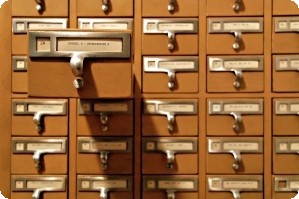
When I was in DC over the holidays, we went to a Smithsonian exhibit called "America On The Move," which was a paean to the car (and RV and camper van and truck) in all its diesel-belching glory. In 1900, there were 500,000 cars on the road; in 1920, there were 23 million of them. That is what's known as a sea-change, and the internet was ours. That kind of overwhelming, what-did-we-do-before kind of transformation has altered the way we do damn near everything: from the comfort of our own homes, we can look up information (and edit it when what we find displeases us), find a mate, shop for books and groceries, consume pornography and listen to music, and communicate. Remember card catalogues? Those long, skinny drawers full of precise and uncontextualized snippets of information about the books housed in libraries? Gone. Those cards are being used for scrap paper. They are literally garbage in the face of digital media.
Is that sad? I don't know. I think part of me misses the time before the internet, because it meant things like phone calls instead of chat windows, and musty, thin-papered reference books instead of Wikipedia. I'm wary of fetishizing the past simply for the it's-old-that's-cool factor, but there was, at one point, space for a variety of ways of existing.
I read an article in the most recent Harper's that summed up the reductive nature of technology. In order to make the machines work for us, with Facebook or standarized testing or Myspace or whatever, human beings have to design a system that is a series of pre-defined choices. You can have a huge variety of choices, but they're not infinite. Facebook asks people for things like their relationship status, and we get to choose from a list: single, in a relationship, engaged, married, it's complicated, in an open relationship, or widowed. There's nothing else. You can leave the space blank, but that doesn't really capture the nuance of someone who is sleeping with a couple people but desperately in love with one of them, or the person who doesn't want a relationship but is down with amiable companionship, or the user who is involved in a passionate and torrid love triangle where the ostensible purpose is to choose a lover, but the thrilling agony inherent in having to make the unchooseable choice is the backbone of the whole experiment. I mean, I guess "It's complicated" covers that, but it doesn't have legs.
Facebook, the article argues, is reductive: it lowers peoples' expectations for self-definition. Thanks to social networking sites, we've come to expect that we'll be asked about ourselves in very specific ways. What kinds of movies and music we like, for example, which, in a vacuum, can come to stand as a way to define yourself. "I like Radiohead and Arcade Fire, so I'm edgy, while you like Britney and Lady Gaga, so you're a minion of the corporate hegemony. I disdain you," etc. While the internet is often touted as a colorful tapestry of self-expression, sites like those actually restrict how you perceive others, and how you are perceived yourself.
Which wouldn't be a problem, but we all spend so much time on sites like Facebook and Myspace. It drains the colour out of a personality: the internet can tell you that your friend is in a relationship, but when it comes to conveying the strange, intimate tics of a person, it lacks heft. Which is fine - Facebook friends aren't really "real" friends, after all, even though it's possible to be both internet buds and real-life amigos - but we think of them that way. And the more time we spend chatting with our "friends" online, or getting to know them by browsing their profiles, the less time we're devoting to actually becoming their real-life friend.
Maybe it has to do with consumption: the internet is mainly useful for people to consume stuff, whether it's online shopping, music, porn, information, whatever. It's not so useful when we're trying to create bonds, because I believe the only way to really get to know someone is by spending time with them. We can't peruse a series of checked boxes and pre-defined categories and really come to know a person; we only think we can, because we've built ourselves an elaborate ruse that says just that.
Wednesday, January 6, 2010
Message In A Bottle
There's something so magical about the dive bars of my misspent youth. Serve me 50 in a bottle, throw some microbrews on tap, stuff a bearded hipster behind the bar and wrap the whole damned place in christmas lights, and we've cracked the code for the Dive Bar©. I'm a person who used to be super-obsessed with high-end fanciness in the food arena - hello, Canoe, I've missed you so - but the special disgustingness of a crappy bar is delectable in its own right.
The Toronto lowbrow bar scene is a veritable wonderland of trashy palaces. From Sneak's to the Green Room, from the Bistro to Tortilla Flats, from the Communist's Daughter in the west over to the east-side Blue Moon, the "decor" is standardized and the drinks are cheap. In the hipper places, you might get some heat lamps on the patio and some overstuffed couches to lounge on. In the real crapboxes, the seats are vinyl and the overhead lighting is flourescent. This are places where the business is drinking, and business is always good.
I love these places, because drinking is inherently a messy thing. Oh, don't let wine snobs and expensive bottles of tequila fool you - alcohol is a poison, just like we all learned in health class. Despite what folks claim about a glass of red wine being good for the heart, booze isn't all that great for your body...although, in the right quantities, it can be good for the soul.
Oh, I know. Not too much. Too much of anything is a bad thing (like how eating too many carrots will turn a gal orange, reason enough to avoid the damned things altogether). I'm struggling right now to define what "too much" alcohol means to me, and dive bars and my affinity towards the seedier side of boozing it up has definitely been both a joy to explore and a burden on the brain. As Mae West said, too much of a good thing might be wonderful, but that wonder doesn't extend to the moment when I can't lie on the floor without holding on.
Much like Oscar Wilde, I myself can abstain from everything except abstinence, which I think is the trick when it comes to both dive bars and alcohol in general. Trying to strike a balance, and then paradoxically trying to make the effort seem effortless, is one of the toughest things I'm working on right now.
Dive bars cut out the justifications, the faux-highbrow snootiness about "notes" and "character" in wine, the city snobs who deign to drink Canadian, and the bullshit. I also strive to eliminate as much bullshit as possible, and that includes lying to myself about what dives bars mean to me. I love them, because that's where they keep the booze, and I hate them for the same reason. It's tough to gunsling your way into a hole in the wall and then ask for a mint tea; the places are designed to feed people alcohol. Tough, but not impossible. I have a feeling that my money is just as capable of buying Diet Coke as it is of buying lager; I only have to put myself to the test to find out.
Sunday, January 3, 2010
National Treasure: Book of Health Care
I just flew back from Washington DC and boy, are my arms tired! God, I love dated, hackneyed humour. Anyway, yes, I just returned from your nation's capital (mine is located in the ice-locked and demi-French 'burg of Ottawa, which is notable for its cuisine and for its proximity to Quebecois gentlemens' clubs) and I thoroughly enjoyed myself.
America just seems so full, you know? There are, like, ten times as many Americans as there are Canadians, in a space that's almost as big as Canada but with way fewer places in which you can potentially fall asleep and freeze solid. Plus, there's all that storied history! The Civil War, the birth of modern democracy, the invention of the atom bomb! Malcolm X, Henry Ford, Neil Armstrong, Shirley Temple! Hollywood, California! New York, New York! Fargo, Minnesota! It's a veritable tapestry of glorious history; you can't spit in Washington without it landing on something that memorializes something or celebrates some other damned thing.
There were some highlights. The Museum of the American Indian, far from being culturally guilt-ridden and boring, was one of the best-designed and -curated explorations of historical and contemporary Native culture that I've ever seen, especially since it encompassed the whole pan-American scene and ran its scope from the Baffin Island down to Chile. Canada was represented well, which is kind of embarrassing when we come home and look for an analogous experience on our own turf. The National Building Museum was totally beautiful, and managed to make an exhibit on parking garages kind of sexy and interesting. Plus, their gift shop was perfect.
There were also lowlights. For those of you residing in the greater Washington area, may I advise you with an expert opinion? The oyster roll at Sakana Sushi equalled 48 hours of food poisoning, including one15-hour stretch that was notable for the amount of barfing it contained (a lot! A lot of barfing!). Might want to avoid that.
But the thing about travel, even to a place just infested with culture - nay, especially to places like that - is that vacation burnout is a total bitch. My entire family caught the same cold. There was the aformentioned food poisoning. Plus, your eyes get tired from reading museum placards, the hotel air doesn't circulate, your feet hurt from doing the tourist-zombie-shuffle, and the hotel pillows are too soft. Eating in restaurants, which is a nice treat when you're at home, is kind of a drag when it's the only option on the road. Whole personal schedules and rhythms are thrown out the window in favour of seeing ever more historical venues and other such trip-necessitated agendas.
Don't misconstrue my tone: I am grateful for the trip. All I'm doing is pointing out that culture-based ventures like the one I'm recently returned from, they're exhausting. Trekking to museums isn't the same as lying on the beach, sipping mai tais and silently judging other people's bathing suit bodies. And we all know from recent experience that family time, especially the extended-remix we tend to indulge in over Christmas time, is rarely the kind of melodious enterprise depicted on TV. There's yelling.
All family vacations are susceptible to that kind of friction, though. What makes a trip to Washington frustrating for Canadians is the inevitable comparison between us and them. Canadians and Americans are both just, like, totally obsessed with America. It's hard not to feel like a weedy younger sibling: America is muscular and burnished with the radiance of her own achievements. The architecture alone practically holds your imagination for ransom, what with its harkening back to the cradle of Western thought and the larger-than-life presidential statuary.
We, on the other hand, invented the robotic space arm.
See? Sour grapes. We're just different, as a mom would point out: America is older, has more money, and is more independent. Canada is gayer, smokes more weed, and has to rely on some lady to play Red Light, Green Light with our freaking government. On the other hand, we don't have Nicolas Cage and Ben Stiller desecrating our collective patriotic memories with terrible pieces of cinematic floss.
Plus, we have free health care. That trumps free museum admission any day of the week. Man, it's good to be home.
Thursday, December 31, 2009
Goal-Setting In The 21st Century
In this current incarnation, I've tried to stay away from the lazy man's blogging, which is just making a list and slapping it on the internet. Don't mistake me: I love lists. But they're not always fun to read. There are the exceptions, like Cracked, which has elevated the fine combination of dick jokes and lists to a museum-worthy art form. Blog lists are usually things like, "Reasons Jesus loves you, personally," and "Stuff I like to put on my cat" and "The top five foods that are making me fat/skinny/clinically depressed" (hint: it's probably dairy!), but those irritate me because they're usually badly written and not really meant to be consumed by the outside world. This is why God invented the journal. And the pen. And the chance to be moody, alone, in private.
With that in mind, let's turn to the topic of New Year's resolutions. A perennial favourite among people who feel guilty and/or like a failure, the resolution can be a powerful way to motivate you into losing those last few pounds or trying new foods. It can also act as a terrible depressant when, in February, you realize you've been mired on the couch since January third and are covered in an orange and carcinogenic drift of Cheeto crumbs. I found a list of resolutions from 1996, when I was, like, thirteen years old, that resolved to "not act so snarky" and "lose ten pounds," which: holy shit, and also: something never change.
This year, I want to try something a little different. Resolutions are all about attempts, trying to strive for some more perfect version of yourself. Lose ten pounds, quit smoking, spent more time with your wife, ditch the lousy boyfriend, write a novel, and the ever-popular go to the gym. It isn't about accepting the person you are; it's about rejecting what you see in the mirror in favour of creating, tailor-made, the future self.
I can tell you with great certainty and experience that being ten pounds lighter (or heavier, for all you dudes who want to bulk up) won't make you a more satisfied person. If you're used to a gym-induced endorphin rush, then yeah, maybe weight loss will be a corollary effect to all that awesome dancing or weight lifting you're doing, but seriously: losing weight through January isn't going to fix it, whatever it is. That same priniciple can be applied to almost every New Year's resolution. The end result (upholding the resolutions) is way less dramatic than the process. On the other hand, having resolutions in the first place never acknowledges that there is a process, and that change is hard work. We're supposed to wake up on January first, yawn cinematically, and start being Father Of The Year.
Apparently, according to my mother (after a particularly effective harangue re: sleeping until noon), it takes about three weeks to create a new habit. I'm not sure I totally believe that, but it seems attractive in January. That's the time of year when everything seems frozen solid - habits, the sidewalk, your love life - and creating a gym-going ray of sunshine could be only 21 days away! But how often does that really happen? Because I can think of about two things in the past five years that happened as a direct result of doing them consistently for three weeks. Getting trim and slim was't one of them.
I think this year, if I go to the gym, it won't be because I said I would feel bad if I didn't; it'll be because I'll feel good if I do. Same with things like giving up drinking and not hemorrhaging money like a goddamned burst artery: better if I don't, not bad if I slip up. I can be a bit (okay, hugely) neurotic and perfectionistic, so trying this little mental exercise could be really beneficial.
I mean, of course I'm still going to make the damned list. I'd be making a list anyway, regardless of whether or not I wrote any of it down. Will I post it on the internet? Nope. This sucker is purely for me. I'll spill the beans on topics like how often I flirt with babies and what kind of pets I like (more than you'd think and none, respectively), but my New Year's resolutions are for my eyes only.
Subscribe to:
Posts (Atom)