Thursday, September 17, 2015

California Nightmares


Since I, and a couple friends, started a writer's group a few years ago, I've noticed a peculiar shift in the way I read. I still pick up books for pleasure, but now I'm more likely to notice all the hinky details and typos, all the tone-deaf tropes, all the thudding dialogue. In short, I am reading more like an editor than a reader, which can kind of ruin the kick-back-with-a-book experience.

Last week, I picked up Edan Lepucki's debut novel California, a dystopian read set in the Golden State after a series of catastrophes, both economic and environmental, kill off millions of Americans. Cal and Frida are a young couple who survive the breakdown by fleeing the rapidly disintegrating city of Los Angeles—with its gated communities, its downtown overtaken by radicals, and its suicide bombers (including Frida's brother Micah)—for the relative safety of woodsy isolation. The two of them are now foragers, hunters, shed-dwellers. Their neighbours are a tiny family of hippies, and they have the most humourless dinner parties in the history of mankind. When the neighbours kill themselves, and Frida starts to think she's pregnant, the two of them strike out for a nearby encampment, one that has been surrounded by spikes and where pirates—strike that, Pirates—have been spotted. Will they be welcomed by the spiky community, or eaten? Is Frida's baby real, or are her symptoms the result of malnutrition? And who is that mysterious bearded man leading the Spikers?

When I read the back of the book, I was like, "Hmm, this has potential." I love apocalypse narratives. They're like puzzles to me. People behave crazily in the best of times, so when you take away their running water, their penicillin, and their easy access to fast food, what happens? I like reading about the interpersonal and interiour dynamics when people really begin to believe that this might be their last night on earth. I love the ripple effect of removing one or two essentials from people's lives (our cushy, late-stage lives) and trying to figure exactly where the waves would come ashore. If we shut down, say, Manhattan's transit system...what would happen? Would taxi drivers become fief lords? If Calgary decided to keep all the oil to itself, would they build a wall? And who would build it? And would they be proud of their good work?

And, it should be noted, I've been obsessed with this idea in my own writing. The last couple years, my poor writer's group buds have been subjected to multiple takes on the end of the world—snowstorms, nuclear strikes, economic collapse, and other, more amorphous sputters—and my attempts to play those out on the human scale. What happens when an introvert needs to join up with a group in order to survive? Where, exactly, does baby food come from after the world ends?

Even when I think I'm sitting down to write a little story about, like, young lovers going skinny dipping, I can't keep the tidal wave out of the background. Some attempts have been more successful than others.

Apocalypse stories work best when they balance the personal with the global. I want to know the scale of the disaster—is it just one or two towns? Or did the entire Pacific Northwest region just fall into the sea?—but I also want to know about the people who're experiencing this. Are they shy, or strident? Do they have kids, or are they still kids themselves? Did they already have guns before shit went down? Do they think Obama is a Kenyan, or Jack Layton was a saint? Do they know how to garden? Knit? Dress a knife wound? Would they hold that information back in order to grab onto some power, or would they share it freely? Do they mourn their dead family and friends? Do they remember the world before it all went to shit? Those questions form the lynchpins to writing interesting apocalypse stories, even if I don't always nail the answers.

So: I had two main issues with California, one cosmetic, one editorial.

The cosmetic problem was one of capitalization. We've had multiple discussions at the writer's group about writers capitalizing certain words to denote significance (turning groups into Groups, land into Land, etc), and the general consensus we've come to is that this is lazy writing. While people do think in landmarks—my convenience store, my Ikea, my grandmother's grave—these tend to be personal landmarks. In the book, these personal landmarks are replaced with monoliths. For example, the bathhouse where people go to get clean is universally referred to as the Bath, but in real life, Susan might call it the bath; Gary might call the place the bathhouse; Daniel might refer to it as the soap shack; and so on. Annoyingly, newly arrived Cal and Frida pick up on this nomenclature almost immediately, despite not being assimilated into the group.

I understand why Lepucki did this (hint: it is easy), but that doesn't mean I like it. Hell, even places in Toronto with actual proper names still get a whole bunch of different titles—I mean, I can barely remember that it's not still the Skydome, and it's been the Rogers Centre for a full ten years now. Names are powerful, and they're one way to actively create and enforce conformity.

The editorial issue I have with California runs a little deeper. These characters are paper dolls. Frida is fleshed out a little more—we know she's a baker who used to like getting stoned—but most of these people are just empty teeshirts. Forget individual characterization; I had a hard time telling anyone not in the main cast apart. Lepucki seems to have taken "show, don't tell," to heart, but then she sort of forgot to do any showing, either. There are moments that I didn't buy in the least, because real people don't behave like these characters do...but characters created solely to serve the plot might.

One of the most annoying things as a writer is when you have this awesome idea for a story, and then people you create to make it happen just don't want to do it. Your story is the minivan, and your characters are the recalcitrant toddlers you're trying to stuff, screaming, into the backseat so you can just get to where you're going. But I can promise you right now that if you, as a creator, populate your writing with characters who are just cogs in the story wheel, they'll come across as stiff, boring, and hard to tell apart. I want backstory, I want details about appearance (exactly how did Astrid lose that tooth?), I want the author to not be afraid of adjectives. I want characters to do things, and for those things to mean something. Lepucki's characters didn't do a lot, and it ultimately didn't mean much when they did. Genuinely disturbing reveals were met with muted or nonexistent reactions, and the plot machine just kept chugging along to Grandma's house.

I genuinely can't tell if this is deliberate on Lepucki's part—after all, in a dytopian world, it's totally possible that people would be flat and kind of soulless—but even characters that were probably designed to be magnetic and charismatic fall flat. The cultish Micah is, by turns, petulant, standoffish, and needy, and it's hard to imagine exactly why anyone follows him. It took me far too many pages to realize that the Land actually hosted two factions (the original settlers and Micah's group), because everyone seemed uniformly capable and uniformly committed to the cause. And that cause, and the steps the Group had taken to support it, revealed slowly over the novel's last third, was probably supposed to be shocking, but would obvious to even a careless reader. Those literal red flag were planted all over the book. The questions about how different personalities might respond to a disaster never get asked, because there aren't enough variations in characters for that to really matter. It's just chug-chug-chug to the finish line.

I felt, at times, like this was a very promising first draft. I was itching to take a red pencil to it, scribble in the margins "Why?" and "How?" and "Tell me what effect this has!" These are the questions we've been asking ourselves at writer's group, and answering them really does make for a stronger story. I don't want to know how—I want to know why. In apocalypse stories, this can be interpreted as "Why did this happen?" but that's not always the right thing to ask. It should be "Why does this matter?" and, that old perennial question readers ask, "Why should I care?"

Image via Joseph Morgan via Future Organization

Friday, September 11, 2015

Our New House


Our new house is the ground floor of a three-story house in Toronto, Ontario, Canada.

Our new house has, depending on how you're looking at it, three bedrooms, or two bedrooms and a TV room, or one bedroom and a TV room and an office.

Our new house has no upper cabinets in the kitchen, and only a corner hutch for storage, but it does have a great big window for looking out when we wash dishes.

Our new house has a gas stove, which makes the rest of the house smell like gas, which is disconcerting.

Our new house has the world's teeniest bathtub, and I have smacked my elbows at least once during every shower.

Our new house has hardwood floors, which is just terrific after three years of carpeting that only be described as "nightmarish."

Our new house is not above a noisy bar. THANK GOD.

Our new house is on a residential street, one or two neighbourhoods west of where I lived for ten years. I'm still getting used to the new landscape—we lost the subway line but gained a streetcar, which might be a step down (but might not be); we got a No Frills, which is thrilling to me; we gained a Portuguese bakery, which supplies the same amounts of cheesecake as Whole Foods but at a fraction of the price; etc, etc.

Our new house is up a hill, which is going to be a bummer for our friends who bike. And us, who also bike.

Our new house is up a hill, which makes the Toronto sky feel bigger than it's ever felt before.

Our new house has kind of a beach-cottage vibe, and since all the light fixtures are from the 1980s, it's sort of like hanging out in the same places I hung out in when I was nine: my grandparent's basement, my parent's as-yet-unrenovated cottage, and my friend's kitchens.

Our new house is silly with things that we haven't yet unpacked, including all our clothes, since, in our new house, there are no bedroom closets.

Our new house is a five-minute walk from the library, and I love that.

Our new house has a terrific bathroom mirror, which throws photo-shoot-worthy light

Our new house has a wee little backyard, with actual grass you can stand on and feel connected to nature.

Our new house has been totally stocked with books and movies, with luscious bedding and various moisturizers, with plants on the windowsills, and with our favourite tea mugs.

Our new house is starting to feel like our new home.


Ilustration from Virginia Lee Burton's The Little House

Wednesday, September 2, 2015

Moving


Some days, it's juuuuust enough to keep your sanity. Days like today, when the humidex in Toronto reached thirty-eight degrees Celsius, and when M and I are packing up our apartment, and I'm wobbling up and down the stairs three hundred times a day for various reasons (everything from flirting with the LCBO clerks so they'll take pity on me and give me more boxes, to surreptitiously leaving various kitchenware goods on the sidewalk in hopes that Good People take our janky pots and pans, to just your ordinary run-of-the-mill laundry day), I started texting my mom in all caps, telling her how hot I was and how much moving sucks. Not just moving house—physically moving my body around was such a drag today. I'll tell you what.

The last few times I've moved, I've had only a room in a house. Sure, I've packed up a few kitchen things and a couch or two, and my wardrobe was probably bigger then than it is now, but this move is on a whole other level. I feel like my books must have been having sex in the night, birthing little baby books that I never read and just sort of stroke affectionately as I pass. Things have changed since my last move. I own actual dishes now! Like, roughly one gazillion wine glasses, and seven cutting boards (I love them all), and many bowls. We have tiny jars of mustard and honey. We have a milk crate full of cleaning supplies. Who bought this stuff? Was it me? Why? I must have been drunk.

I know I should be in Marie Kondo mod—picking each item up, asking myself if it makes me feel joy in my body, and if I don't, thanking it for its service—and to be fair, I tried that. For like an hour. And then I just started flinging stuff into boxes and hoping that when I unpacked, I would still be able to tolerate this stuff. Fingers crossed! I packed up thirty cassette tapes! I haven't had a tape player in years!

Moving is really hard. Moving in August is hard. Moving in August while pregnant is hard and a little dumb. M and I are both at Defcon 1, and I'm picking fights and he's taking the bait. Today we argued about whether or not he could change out of his soaking-wet, just-in-from-the-rain clothes before we scurried out to get even more boxes. This is the level we're at today. It's really not our best moment.

I keep trying to take the long view: this, too, shall pass. M's mantra this month has been "the mess is only temporary," and it is. We will pack, then move, and then unpack, all this stuff. Some of it will be perfectly at home in the new place; other stuff, I'll just look at and laugh. What could I be thinking, packing chipped mugs I don't like, dead plants, photos of people I no longer know? Away with all of it, seriously.

This move will be the first time M and I create a home together from scratch. It'll be the first time I leave the Annex, where I've lived for close to twelve years. It's a whole new landscape: new grocery stores, new transit stops, new topography. I am nervous, I am excited. I am ready to be there, for this step to be over. I am ready for September to really begin.

Friday, August 28, 2015

The Big News: Pregnancy Q&A


The big news around our house this summer is that M knocked me up (respectfully, lovingly), and come January 2016, our family band is getting a new tambourine player. I'm now halfway through my very first gold-plated pregnancy, which means that I have just enough experience being pregnant to write a universally useful FAQ (Ed.: FAQ may not be universally useful). Feel free to leave your own questions in the comments, and I will answer them!

Q: How did this happen?

A: Well, when a mommy and a daddy love each other very much, they do a special hug and then they invest heavily in all sorts of quickly-outgrown plastic baby paraphernalia.

Q: Seriously, though.

A: Okay, seriously, the way it happened was roughly 1,000 hours of conversation, some very steamy and fun sex, and then a panic attack when it actually worked. I had been told for the past five years that making a baby was probably going to be a complicated and lengthy procedure for us, due to only having one ovary, and we were both gearing up for months of carefully-timed marital fun. But, because we live in a hilarious universe, it only took a month. To be honest, it's still sort of sinking in.

Q: What is morning sickness really like?

A: Imagine a hangover mixed with PMS. The hangover part is the constant fatigue, nausea, and oopsy-doodle barfing and dry-heaving that you may find yourself doing in inopportune times and places (example: I once threw up on a mini-golf course); the PMS is the mood swings, breast tenderness, and heightened sense of smell that will allow you to sense tuna salad from three counties over. While I've heard horror stories about women vomiting every single day of their pregnancy, or puking so hard they cracked teeth, my own case was fairly tame—and, from what I've read, fairly typical. I felt off-and-on nauseous for about six weeks, but it peaked over ten days, which was spent mostly on the couch. (I watched all of Happy Endings. ♥ u, Brad and Jane.)


Q: Any weird food cravings?

A: I developed a complete aversion to meat and vegetables—which, as someone who ate a Paleo diet for the three years leading up to the pregnancy, was a bit of a hard reset on my system. Instead, I ate tortellini with pesto for ten days straight, pausing only for ice water with lemon and peanut butter on wild-rice toast. Gird your loins for lots of carbohydrates, is what I'm saying. I'm pretty much back to normal now, save for a pizza fanaticism that continues unabated.

Q: How is it getting all fat and stuff?

A: Honestly, this is a totally different type of shape. My belly is hard and smooth right now, and I can still see remnants of my obliques. I really like pressing down on my stomach and feeling my uterus spring back against my fingertips, and I've even sort of enjoyed the process of outgrowing all my pants. As this progresses, I'll likely get more swollen and rounder, but I am feeling shockingly, surprisingly, gratifyingly body-positive right now.

Q: Can I touch your belly?

A: Yeah! I'm into it. Unless you're a stranger. But everyone should ask first.

Q: Can you feel the baby kick?

A: Yes! I think so? Or it might be gas? But I'm pretty sure this little critter is doing its aquafit classes in my too-small pool, and I'm starting to feel the bumps.

Q: Maternity fashion—discuss.

A: IT IS A WASTELAND. I insisted on wearing civilian clothes (I'm refusing to call them "skinny clothes" or "normal clothes" or whatever, because who even has time to feel bad about being big and different when you're growing a life inside yourself, am I right?) until I was nineteen weeks pregnant—nearly four and a half months, or halfway to the big finish—because the maternity clothes I saw at Value Village and online were an enormous frumpfest. You know that "office-appropriate" poly blend that Reitmans and Smart Set buys in bulk? Maternity clothes are made pretty much exclusively out of that. SO TERRIBLE. And, I am all for body-con fashion, but maternity tops all seem to be cut in a peculiar way that both emphasizes the bump and also embiggens it. I swear I put on an H&M Mama tunic and looked a month further along, easily.

Q: Do you know what you're having?

A: We are currently hoping for a baby, although I also would be interested in the National Enquirer money if Bat Boy somehow showed up.

Q: Oh, ha! I mean, are you having a boy or a girl?

A: Yes.

Q: Hey, wait a minute...

A: I'm of the opinion (emphasis on opinion; YMMV) that boy-babies and girl-babies are pretty much the same thing, really. I know it sounds sort of dumb, but hear me out: you wouldn't expect a boy to start walking at a year and a girl to start at fifteen months, would you? Or for a girl to sleep through the night any earlier than a boy? Would you read them wildly different board books, or feed them different flavours of pureed squashes? I love baby clothes and baby toys as much as the next Pinterest-obsessed gal, but I also love the idea that our kid will have the option to play with dolls and trucks, with frogs and Easy-Bake Ovens, with Spiderman and Supergirl, pretty much from the get-go. Not to mention that the first year or so is basically are-they-eating, are-they-sleeping, are-they-breathing, wash rinse repeat. No doubt we'll get clothes, toys, and supplies (and, if it's a girl, those weird headband garters) that spell out exactly what sex the baby is soon enough. This little reprieve, before "the baby" becomes "grandma's little princess" or "daddy's little fireman," is lovely.

Q: Are you going to have a home birth?

A: No way. I'm heading to Mount Sinai with a midwife in tow. Labouring at home, or at the Toronto Birth Centre, meant that there were going to be very few on-site pain relief options—laughing gas and TENS, basically—and if anything went weird, it would require a trip to Mount Sinai in January weather. Besides, we rent, and we didn't want to ruin someone else's floors.

Q: Hospital, birth, eh? You're going to be drugged to the gills! I read this study—

A: Let me stop you right there. While I'm planning on trying to have an unmedicated, quote-unquote "natural" birth, I'm not an idiot. Medical procedures—and in the twenty-first century, birth is, like or not, a medical procedure—often have a way of throwing wrenches into the mix. (For example, when I had an ovarian cyst surgically removed five years ago, the damn thing burst, making that procedure twice as long as originally planned, and filling my abdominal cavity with goo. Not predicted! Unexpected! Relatively dangerous!) I know that birth plans aren't written in stone, and that things arise during late-term pregnancy and labour. From a prolapsed umbilical cord to a big-ass baby who gets stuck, or placenta previa or preeclampsia, or even just a long, drawn-out, exhausting labour: a lot can happen. Medical intervention and pain medication are good things when they do.

As for that super-helpful study you read about when you were on an airplane and sneaking your wife's magazine...can it. Casting a judgmental eye on anyone's birth experience, or birth plan, reinforces the idea that there are only one or two right ways to have a baby. In reality, there are thousands of babies born in Toronto each year, and each one of them got here in a slightly different way, using a slightly different method, under a slightly different process. Ain't none that was better than all the others, son.

Q: Are you taking maternity leave?

A: Nope, because as a newly self-employed person, I am sadly not eligible for any type of maternity leave right now. The government has a program called Employment Insurance Special Benefits for Self-Employed People that works the same way regular EI/maternity leave does; the catch is that you need to sign up for it a full year in advance of actually collecting any money. Since the geniuses at the Canadian government apparently all took their sex education in Arkansas, it seems to have slipped their attention that pregnancy lasts for all of nine months. I signed up for the program as soon as I began working for myself in April, but our kid will be at least four months old before I could collect any parental-leave benefits. It is not an ideal situation.

Q: So you're going to work with a baby at home? 

A: Save for the first month or so, which I would love to take off fully, that's the plan. So, you know, if you're feeling like you want to set up some sort of "Save Kaitlyn's Early Motherhood Sanity" fund to help offset that month of lost income, that'd be dope. Otherwise, just be gentle on me for email turnaround time.

Q: Are you scared?

A: Terrified. For the first three months, I was terrified of miscarriage. Now, I'm terrified of the actual baby that's going to come out of my actual vagina and then live with us for the next eighteen to thirty-five years (let's be real, it's not the 1970s anymore, this kid will be with us forever). I'm scared of being poor, of being a bad mother, of losing my temper. I'm scared of how this will fundamentally change my relationship with my husband, with my own parents, with my friends, and with my body. I'm scared of losing my "self," the person I worked so hard to become, in this new identify—and I'm also scared of holding myself back from fully embracing this baby, in a misguided sense of self-preservation. I'm scared of sleepless nights, of the baby licking the electrical outlets, of schoolyard bullies, of mean teenagers, of telling this kid I used to smoke cigarettes, of dropping them on stone patios, of drowning, of "where do babies come from?", of child molesters, of peanut allergies. I'm worried I'm going to alienate all my friends by having nothing else to talk about. I am worried our kid will be an asshole, or turn us into assholes. I'm worried that this baby will arrive and I will not like being a mom.

Q: Wow, that's quite a list. 

A: Yeah, like I said, the pregnancy hormones ramp everything up to overdrive. My brain is now just a swamp of emotions, and I haven't had a coherent thought in four months.

Q: So, um, are you excited?

A: You better believe it. I'm excited to meet this new person—this brand new person, who never existed before! I'm excited for story time, and for introducing them to books I read when I was a kid. I'm excited to watch my husband tuck them into bed at night. I'm excited for family outings to the zoo and the aquarium. I'm excited for all the milestones: first smile, first word, first brunch, first bike ride. I'm excited for little baby cheeks, for tiny sunhats, for bath time, for snoozing together on the couch. I'm excited for favourite blankets, for new-food faces, for living room dance parties at 6:30 PM because the kiddo goes to bed at 7. I'm excited for public tantrums at Medieval Times, for walking with them in the snow, for summer trips to Granddad and Amma's house. I'm excited to watch them grow and learn, to see new skills come up out of nowhere, to marvel at their personality quirks. I'm excited to be involved from the very start. I'm excited for a chance to fall in love. I'm excited for the chance to fall in love with M in a different way. I'm excited for their new life, and for ours.

Wednesday, August 5, 2015

Breaks


This has been a hard month, for a number of reasons: personal, emotional, financial, professional. I was gone for a week, away from all computers and technologies, and now I'm back. Oddly, instead of feeling recharged, my batteries still feel drained, and I'm not really sure why.

I'm going to take a couple weeks off from this blog. I want to recalibrate, ask myself some questions—why do I write for the internet? What types of content are okay, and which aren't? Who reads it? Why? What do I get out of it?—and see what kind of answers I land.

I'm not sure if this is me hitting a pause button, or pressing eject on the whole shebang. I'm not sure if it's the last few weeks talking, and after my little exile, feel better, but it does feels like it could go either way.

Image by Philip Ob Rey

Saturday, July 25, 2015

Food on Four Wheels

One of my favourite things from our California honeymoon last fall was a night out in Venice Beach's Abbott Kinney neighbourhood. Abbott Kinney is sort of what would happen if Toronto's Kensington Market met Yorkville: it's got a beachy, hippie vibe, but also cashmere sweatshirts that cost $400. I loved it, because it felt self-contained in a way that a lot of Los Angeles didn't. Toronto is made up of an archipelago of neighbourhoods, while LA seemed like more an oozing sprawl. (I say this with affection, of course.)

In Abbott Kinney, we shopped, walked up and down the street, stopped in for dinner at an upscale resto, drank delicious cocktails, and basically acted like we had more money than we do. When we left the restaurant, the sidewalks were still buzzing with people, most of whom were there for the First Friday festival. There were dozens of food trucks at the curb, each hosting two groups: one of hungry Angelenos clutching cash, and a second of dreamy-faced eaters who were snacking on everything from gourmet cotton candy to Korean short ribs. Meanwhile, the restaurants that lined the other side of the sidewalk were wrangling lineups of their own.

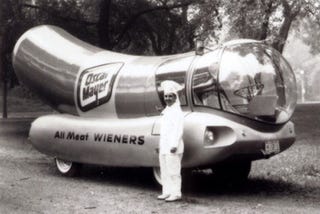
It was a scene to give Toronto City Hall the willies. They've been adamant that food trucks will be the death of the traditional dining experience, and that this menace on four wheels will one day overtake bistros, cafes, and restaurants and leave us all out on the sidewalk.

I think this is crazy. I am biased—after all, we had a food truck cater our wedding—but there seems to be several major bonus to encouraging a local food truck scene.

First of all, from an economic standpoint, there are a couple key differences from a brick-and-mortar place.  Fun fact: restaurants are expensive, yo! People need to get a lease, buy all this equipment, hire staff, get a liquor license, decorate, design a full menu, &c, &c, &c. A recent National Geographic article pegged the average start-up costs for a food truck at 75 grand, while a "real" restaurant clocked in a cool quarter-million dollars.

Putting together a full kitchen and a full menu is a ton of work. Food trucks have smaller, more specialized menus, which mean that the space to cook in can be highly specialized. (If you don't have to have both a deep-fryer for your calamari appetizer and a freezer for your chocolate gelato dessert, you can use that space for equipment you actually need.) Not having space for more than two people on the truck means that you can't hire more than a handful to run your whole business, keeping your staffing costs lower.

Lowering the cost of entry means that more people can afford to do it, giving a wider range across the socio-economic spectrum. It also means creativity: if your specialty is, say, hot dogs, then how many variations can you offer? How about dumplings? Hand pies? Ice cream bars? Narrowing your focus can mean a sudden influx of a-ha moments. (No topping hot dogs with ice cream bars, please.) And let's not forget the cultural diversity. Many of the American food trucks focus on regional cuisines, such as Mexican, Egyptian, Korean—Toronto, as one of the most diverse cities in the world, is already comfortable with eating all over the map. Show me a Toronto schwarma restauranteur who wouldn't be equally happy running a food truck.

Plus, you're mobile. Run out of food 3/4 of the way through a busy night? You don't have to deal with hungry customers who have been sitting for twenty minutes while you scramble to figure out if you can somehow combine chives, orange juice, and carrots to make the tortellini with pesto they ordered. You can just drive away. You can also chase your market, going from the construction worker crowd, who eats their first lunch at 10 AM, to late-night party girls who won't touch a carb when sober but who will happily wolf down a burrito at 3 AM.

That's not to say that food trucks are perfect. It's hard to prep meals for a hundred people in a space the size of a walk-in closet. Like any food business, profit margins can be slim, and it's damned hard work. More than a traditional restaurant, food trucks have to be on it with social media; after all, it doesn't matter if you have the best gyros in the city if nobody knows that you're down on Cherry Street today. Twitter, Instagram, Facebook, and being listed on various food truck finder apps are all required to build a following; then again, most of those tools are free. 

So why am I singing the food truck's praises so hard? Because Toronto has been usually strict in regulating how and where these business can operate. For years, they had to be at least 50 meters away from an open business, and could only stay in the same spot for three hours; now it's thirty meters and five hours. There are less than 200 food trucks licensed in Toronto (this doesn't include the nearly 150 ice cream trucks, who don't face the same restrictions), and checking the Toronto Food Truck app reveals that many of the trucks listed there operate well outside of the GTA: Collingwood, Kitchener, and Barrie all get hits. In trying to protect the established restaurant industry, Toronto seems unwilling to believe that food trucks can co-exist with a relative level of harmony.

In Los Angeles, meanwhile, food trucks have their own professional association, a real-time website revealing current locations, and it's part of an $800M annual national industry. It's seen as a natural extension of the city's vibrant foodie scene, and a showcase for the city's ethnically diverse population. Food trucks are big business there, and they're not confined to the sidelines. In other cities, food trucks have been seen as a menace to local business, but one blog I read compared the conflict to record labels vs. online music downloads. In other words: things evolve, so evolve with them.

I feel like this could be part of an ongoing lament of how Toronto lags in comparison to other cities. From art-school gift shops to public transit to families stuck in tiny condos to city parks that close in order to host international games, it's hard not see the cracks in Toronto the Good's facade. I want Toronto to be better. I want this city to be as innovative as it thinks it is, and to innovate outside of the white-dude, middle-aged, working-with-a-pension box that is slowly falling apart. Food trucks aren't the only way Toronto could take on that challenge, but they certainly are the most delicious.

Thursday, July 16, 2015

Things I Was Wrong About


Following is a list, by no means complete, of erroneous opinions, reconsidered thoughts, and retracted statements belonging to yours truly:

  • Carbohydrates. They are delicious. Paleo works like a top to keep me lithe(ish) and supple(ish), but there is just no substitute for tortellini with pesto.
     
  • Dungeons and Dragons-themed games. Specifically, Lords of Waterdeep, which is fun and easy to play, and has a level of mystical nerdiness that's still accessible if you don't happen to be a middle-school dork.

  • How I Met Your Mother. That show, along with Friends, has aged horribly. It's sexist, transphobic, misogynist, commitment-phobic, and worst of all, it gave the world Barney Stinson. I'm sure that Neil Patrick Harris is a peach IRL, but Barney Stinson was a woman-loathing manchild Lothario in a nice suit. (It should be noted that Ted Mosby also sucked, but in a completely different way.) I hate that, for a while in the mid-2000s, Barney Stinson became a cultural touchstone, and that I was initially sucked in by this show.

  • Los Angeles is hot, sunny, easy to navigate, attractive, and has great food trucks. I think too much early exposure to Woody Allen had convinced me otherwise.

  • Woody Allen in general, come to think of it.

  • I stand by my opinion that space colonization is morally wrong (I'll get into it someday, but basically: we're not entitled to any damn planet we can get our grubby hands on; we have no way of knowing if our presence on another planet would be devastating to another species [or devastate the conditions that would allow another species to grow and evolve]; and the money, time and resources that we put into getting to and terraforming another planet would be much better spent on earth, for things like alternative energies, birth control, and hunger relief), but I will admit that seeing Pluto was pretty cool. If it's possible to be for space exploration and against space colonization, I choose that.

  • Though I can't watch Hannibal because it gives me the fear-barfs, the show is beautifully shot and artfully produced. The odd episode that I've seen since I swore it off after season one has been gorgeous, and its insistence on both tactile glamour and Carrie-levels of gore is super weird for a prime-time network show. And honestly, it's only gotten more baroque and insane as the seasons went on, which made it the perfect counter-balance to all the by-the-book crime dramas that seem to run for hundreds of thousands of seasons. To all the people who embraced Hannibal with their whole, sick hearts: I'm sorry for your loss. 

  • People who say "we're pregnant" aren't total monsters, probably.

  • The second season of True Detective is just not living up to its potential. (Insert "disappointed high school vice-principal sigh" here.) I miss Cary Fukunaga! I miss Woody Harrelson! I'm glad Rachel McAdams is there, and that Bird-Mask is around, because they seem fun. But good goddamn, I do not care at all about Taylor Kitsch's 1980s-era cartoon tortured-gay-guy character,  and Colin Farell leaves me cold, and without Woody Harrelson around as an eye-rolling audience proxy, Nic Pizzolatto's the-world-is-a-vampire schtick, delivered this season from Vince Vaughan's unconvincing maw, reveals itself to be grating and pretentious. I believe that this season can turn it around; I don't thing it'll live up to the art of season one, and I think the potential to develop it into something truly cool—which, on paper, with the gangsters and the high-speed trains and LA's seedy underbelly and the promise of the occult, it definitely had—is rapidly running out of time.

  • Chicken hearts. When you grill them, they're like tiny hot dogs. Who doesn't want tiny hot dogs?

  • The mesh shirt that I bought from Value Village as a joke, which I never thought I would wear out of the house, which has been a godsend to me on hot days, and which has forced me to confront and celebrate my body—which, despite its flaws, I find myself being amazed by. Through the mesh. Through the raver-adjacent, too-young-for-me, inappropriate-everywhere mesh. I love this stupid mesh shirt.
Image via Valfre